Perfidious Albion and the demise of Conservatism
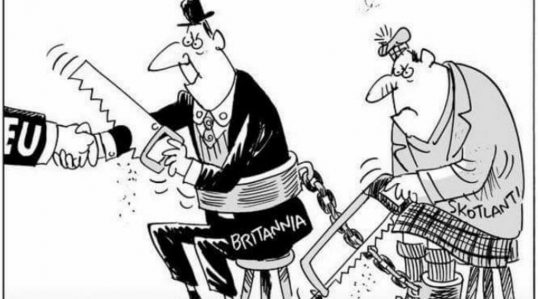
Perfidious Albion and the demise of Conservatism Gerry Hassan Scottish Review, September 16th 2020 It has not been a good week for the UK’s reputation - domestically or internationally. Boris Johnson’s shameless government of chameleons and charlatans showed their true colours by declaring their intentions to run a horse and cart through international law. To make matters worse this was not on some arcane or ancient piece of legislation but rather the Brexit Withdrawal Agreement negotiated between the UK and EU in November last year and which provided the basis of the emphatic Tory election victory in December. All of
Continue Reading Perfidious Albion and the demise of Conservatism

The UK is a Rogue State
The UK is a Rogue State Gerry Hassan Sunday National, September 13th 2020 The UK Government took the UK’s reputation to an all-time low in the past few days. Tragically, Britain’s descent into potential illegality, breaking agreements and weakening peace in Northern Ireland comes as no surprise. Even if part of this bravado turns out to be bluster and bluff, this deep chasm at the heart of UK government and elites will have lasting damage. We have travelled a long and painful journey to get to this point. One which says much about the state of Britain, degeneration of

Border troubles point to the long-term crisis of unionism in Scotland and the UK
Border troubles point to the long-term crisis of unionism in Scotland and the UK Gerry Hassan Sunday National, July 5th 2020 Reaching 100 days since the start of the UK lockdown was always going to be a milestone, but in many places it has been marked by a kind of cabin fever irritability and over the top remarks. Boris Johnson attempted to convince voters that he was the inheritor of Roosevelt’s political ambition and wanted a ‘New Deal’ in a speech he made in Dudley - whilst 56 miles away, the residents of Leicester were having to deal with a
Continue Reading Border troubles point to the long-term crisis of unionism in Scotland and the UK

Is Boris Johnson the most incompetent UK Prime Minister in living memory?
Is Boris Johnson the most incompetent UK Prime Minister in living memory? Gerry Hassan Scottish Review, May 13th 2020 This is a time of national and international crisis. Governments and leaders need to step up to the plate; be honest, open and adaptive, and treat their citizens as adults who know these are difficult times and that inevitably mistakes will be made. In this environment Boris Johnson and the UK Government have had numerous advantages: newly elected in a December election with a comfortable majority of 80, a Prime Minister known for his ability to communicate, and with a relative
Continue Reading Is Boris Johnson the most incompetent UK Prime Minister in living memory?
Is Britain Broken? And what should we do in this election and beyond?
Is Britain Broken? And what should we do in this election and beyond? Gerry Hassan Sunday National, December 8th 2019 The United Kingdom is not a happy place at the moment. This has been a strange, unsatisfying election campaign. People feel ignored and distrustful of politicians. But more than that, they don’t feel that they own what passes for democracy. This has a longer tail than this election. A host of factors have contributed to the current state of Britain. There is the UK’s struggle to find a global role post-Empire. The dependency on the so called ‘special relationship’ with
Continue Reading Is Britain Broken? And what should we do in this election and beyond?
The Last UK General Election Ever? Or the Last Bar One?
The Last UK General Election Ever? Or the Last Bar One? Gerry Hassan Sunday National, October 27th 2019 Boris Johnson on Monday makes what is his third attempt to get the votes to call a UK general election – needing 434 votes to win a two-thirds majority under the Fixed Term Parliaments Act. This piece was written before the moves by the Lib Dems and SNP to bring about an election on December 9th via a simple, single line bill. This may have more chance of succeeding later this week. But whether it does or does not it doesn’t invalidate
Continue Reading The Last UK General Election Ever? Or the Last Bar One?
Does Boris Johnson’s ‘deal’ pose the end of the Union?
Does Boris Johnson’s ‘deal’ pose the end of the Union? Gerry Hassan Sunday National, October 20th 2019 It has been another tumultuous Brexit week. But this is not the end of Brexit, or even the beginning of the end, but just another staging post in this drawn-out process. Fundamental to the Johnson deal is what is proposed for Northern Ireland. In place of the so called ‘backstop’ the province is instead put in a special place in relation to the rest of the UK and EU. It remains legally in the UK customs territory, while practically remaining in the EU
Continue Reading Does Boris Johnson’s ‘deal’ pose the end of the Union?
The future of the Scottish Tories after Ruth Davidson
The future of the Scottish Tories after Ruth Davidson Gerry Hassan Sunday National, September 1st 2019 One constituency consistently admired Ruth Davidson - the media. As in her eight years of Tory leadership, the same has been true of her resignation; with numerous plaudits, magnified by how the London media misunderstand and misread Scotland. One example was provided by BBC ‘Newsnight’s’ programme on Thursday evening when Ben Chu opened his Ruth Davidson film with the proclamation: ‘She was an election winner with a gold dust appeal to millennials’, which was completely wrong in both its assertions. In her period as
Continue Reading The future of the Scottish Tories after Ruth Davidson
The Death of Tory England and the Decline of The Spectator
The Death of Tory England and the Decline of The Spectator Gerry Hassan Scottish Review, May 15th 2019 For eighteen years I have subscribed to and enjoyed reading The Spectator magazine. But under Fraser Nelson’s editorship from 2009 the magazine has slowly and irrevocably gone downhill and into the gutter. Gone are the days when it was a civilised, gentle, iconoclastic read where an article could surprise and entertain from unusual angles. Good pieces still occasionally appear, but in the midst of a very different content. One that is often nasty, condemning, quick to judge people, and with a sense
Continue Reading The Death of Tory England and the Decline of The Spectator
As Labour and Tories splinter the old political order is broken beyond repair
As Labour and Tories splinter the old political order is broken beyond repair Scottish Review, February 20th 2019 Gerry Hassan The Labour Party have finally split after months of rumours – with so far eight Labour MPs resigning from the party and three senior Tories joining them – and numerous stories of many more considering their position in both parties. This may or may not amount to a seismic meltdown of Labour and of two party politics as we know it. But something is rotten and deeply wrong with British politics. This is usually portrayed as the product of Brexit
Continue Reading As Labour and Tories splinter the old political order is broken beyond repair