Can the Green Surge come to Scotland?
Can the Green Surge come to Scotland? Sunday National, 26 October 2025 Gerry Hassan Zack Polanski’s recent election as leader of the Greens in England and Wales was a major moment in UK politics. It has acted as a lightning bolt, offering hope to many who want to see the existing Westminster consensus and rightward drift of UK politics reversed. Green membership in England and Wales has exploded; in the past week it has surpassed the entire UK membership of the once powerful Tories. Several polls have shown the Greens not only rising across the UK but closing in on
Lonely at the Top: Sturgeon, Leadership and Regrets: Review of Nicola Sturgeon, Frankly, Macmillan £28.
Lonely at the Top: Sturgeon, Leadership and Regrets Bella Caledonia, 15 August 2025 Gerry Hassan Frankly is a major political occasion which has got people talking and taking sides – either defending or defenestrating Nicola Sturgeon as a leader, politician and her legacy. Sturgeon invites strong reactions. There are those who feel loyalty, even affinity, to her and what she represents. Equally there is a significant body of opinion who regard her as divisive, out of touch and having let down people – a view shared even by some in the SNP and pro-independence. There is no doubt that this
Scotland and Independence need a new approach and agenda
Scotland and Independence need a new approach and agenda Sunday National, 27 July 2025 Gerry Hassan John Swinney recently engaged in the latest relaunch of independence. Some people noticed; some even cared and thought it relevant. Mostly his efforts passed unnoticed, without any real impact. Scottish politics, democracy, government and independence are not in good health and failing too many people. Some don’t see things this way. They measure the state of Scotland by saying we are not like the collective disaster of Westminster as if this is an effective measurement. Others say we need independence now such is the
Continue Reading Scotland and Independence need a new approach and agenda
Notes on a Scottish Republic of Letters
Notes on a Scottish Republic of Letters Bella Caledonia, 7 July 2025 Gerry Hassan The health and vibrancy of the Scottish cultural landscape was once acclaimed across public life. Not so long ago many folk felt that we had been living through a renaissance of expression and talent, not unlike such periods as the 1930s, and that this had lasting import on how we viewed ourselves and on our political disposition. Today things are a lot less rosy and sure-footed. Instead of the above, there is now a discernible mood of angst, worry and negativity - centred particularly on funding,
After Hamilton, Scottish Politics and the Cause of Independence
After Hamilton, Scottish Politics and the Cause of Independence Bella Caledonia, 6 June 2025 Gerry Hassan Hamilton, Larkhall and Stonehall has proven to be a consequential Scottish by-election. Not of the mythical levels of Hamilton 67 or Govan 73, but contests like that are few and far between. Yet in a world where by-election aren’t what they used to be, it has thrown significant light on Scottish politics and the major protagonists. Labour gained a seat from the SNP, against the expectations of the commentators and prevailing wisdom which says much about both. The SNP and Tories suffered major
Continue Reading After Hamilton, Scottish Politics and the Cause of Independence
The Road from 2014 is Over: A New Road Map is needed for Scotland and Independence
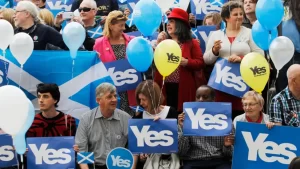 The Road from 2014 is Over: A New Road Map is needed for Scotland and Independence Sunday National, 27 April 2025 Gerry Hassan Scottish politics has had some climatic moments recently - the UK Supreme Court decision on women’s and trans rights; the SNP and Labour trying to deal with the challenge of Reform; and the brief excitement of an opinion poll with a sensational degree of independence support. Beyond this Scottish politics is characterised by drift and by being in the doldrums with a lack of dynamism, direction and purpose –
Continue Reading The Road from 2014 is Over: A New Road Map is needed for Scotland and Independence
After Sturgeon and ‘Sturgeonism’: Facing Up to the Democracy of Scotland
After Sturgeon and ‘Sturgeonism’: Facing Up to the Undemocracy of Scotland Bella Caledonia, 25 March 2025 Gerry Hassan The past week has seen the end of a monumental era of Scottish politics: of Nicola Sturgeon’s SNP and of ‘Sturgeonism’. This has generated a welter of instant commentary as expected but with much of it focusing only on the immediate, the party’s prospects for 2026 and what Sturgeon might do post-politics, rather than look at the longer story in addressing how we got here and where this might take us. There was lots of over-the-top commentary as there always has been
Continue Reading After Sturgeon and ‘Sturgeonism’: Facing Up to the Democracy of Scotland
Get Ready for the Age of Disruption Coming to Scotland
Get Ready for the Age of Disruption Coming to Scotland! Sunday National, December 29th 2024 Gerry Hassan Politics everywhere across the West is shaped by failure, exhaustion and unpopularity in the mainstream - and increasingly by anger and rage amongst voters. Both Scotland and the UK are no exception. Labour’s election victory with 34% of the vote was the smallest in history for a party winning an overall parliamentary majority. Since then it has been downhill all the way with a government showing a lack of sure-footedness and political acumen on issue after issue, and with no sense of how
Continue Reading Get Ready for the Age of Disruption Coming to Scotland
Ten Years on from 2014: Making Sense of the Next Ten Years of Scotland
Ten Years on from 2014: Making Sense of the Next Ten Years of Scotland Gerry Hassan Sunday National, 29 September 2024 The ten-year anniversary of Scotland’s indyref has come and gone relatively unmarked. For something which shook things up so much it was very quiet and understated, a low-key affair from every political persuasion, media and academia. This does not mean that the ten-year point is not significant. Rather it is a time to pause, to draw breath and reflect on what has passed, on the bigger context and forces changing Scotland and the UK, and what the future may
Continue Reading Ten Years on from 2014: Making Sense of the Next Ten Years of Scotland
Scotland Ten Years on from the Indyref
Scotland Ten Years On from the Indyref Gerry Hassan Bella Caledonia, 18 September 2024 Ten years ago today Scotland voted 55% to 45% to remain in the UK union and against independence. This was a momentous, historic watershed under which we are still living, not yet having come to terms with its consequences and continued influence. Many across the political spectrum, pro and anti-independence, have struggled post-2014. But most of the mainstream politicians who participated in the 2014 campaign, including SNP senior figures and strategists, failed to see the indyref at the time in its wider context - of a